 Rebecca Hunter
903 Cedar Ave.
Elgin IL 60120
Telephone 847-697-4551
www.kithouse.org
rebeccahunter1216@gmail.com
Working with the Elgin Illinois Heritage Commission, Hunter located and photo-documented over 300 mail order homes in Elgin. Hunter's books, Elgin Illinois Sears House Research Project and Beyond Sears: Mail Order Homes in Elgin Illinois from Gordon-Van Tine, Aladdin, Lewis, Sterling, Montgomery Wards and Harris Brothers are available in Elgin’s Gail Borden Public Library. Her books Putting Sears Homes on the Map and Sears, Roebuck Book of Barns were published in 2004 and 2005 respectively. Mail-Order Homes was published in 2012. She is planning books on Harris Brothers Mail order buildings and Gordon-Van Tine barns.
Hunter has spoken at the American Institute of Architects, the Sears Home Owners Association, public libraries throughout the state of Illinois, and at numerous meetings of historical societies, clubs and associations. She was a speaker for the Illinois Humanities Council Speaker's Bureau for ten years. She has done historical architectural consultation for Elgin, West Chicago, Downers Grove, Joliet, Libertyville, Lombard, Berwyn, Crete, St Charles and Springfield IL, as well as Minneapolis and St Paul MN, Sylvan Lake MI, Hartford WI and Anderson IN.
Articles about Hunter and her research have appeared The Chicago Tribune, the Christian Science Monitor, the Elgin Courier News, the Daily Herald, and numerous local publications. She has served as a consultant for articles in the New York Times, Wall Street Journal and Bungalow Magazine. Her work was featured in an article in March 2008 Cottage Living magazine. Hunter is a recipient of the Elgin IL Mayor’s Award for Historical Preservation, Elgin Image Award and the Elgin IL Genealogical Society’s Heritage Hall of Fame Award.
Hunter is available for consultation about individual houses, for conducting surveys of municipalities, and for presentations, lectures and workshops on mail order buildings, historic preservation, architectural salvage and other topics.
An Architectural Historian, Hunter sits on the Elgin, Illinois Heritage Commission.
HISTORICAL NOTES ON KIT and PRECUT HOMES
[Based in part on research by Dale Wolicki, Bay City Michigan
Historical Society]
General Information on Precut Homes
What IS a mail order house?
These homes were marketed by mail order catalog from 1906-1982. Eight major companies, and a host of small local companies, sold these homes primarily in the USA, but also in Canada. The company provided building plans and materials to construct the home. The materials were provided either as bulk lumber, or more commonly as precut framing boards. The latter were known as “kit” homes. The buyer received all the materials from one source: lumber, roofing, doors and windows, flooring, trim boards, hardware, nails, and enough paint and varnish to put 2 coats on everything. Electric, plumbing and heating fixtures were NOT provided as part of the house, but were available at extra cost. Materials were shipped primarily by rail, but also by boat, depending on the location of the plant and of the purchaser. Most buyers ordered from the closest supplier, as the buyer paid the freight charges.
These well-designed, practical, homes were made of top quality materials. Lumber and hardware were purchased in bulk then the structural elements were cut to exact size at the mill and shipped to the customer by rail. Manufacturers claimed the pre-cut system would save the builder up to 30% compared to the cost of standard building methods.
These houses were usually not distinctive architectural designs, but copies of the most popular styles of the day. House designs were standardized to reduce waste in materials, but customers were encouraged to personalize their order by moving windows or doors, adding porches, fireplaces, sunrooms, window boxes, trellises, or built in cabinetry, and by selecting exterior finish and colors.
In the days before home power tools, precut homes represented an enormous saving in labor and materials for the home-buyer. Catalog prices typically included only the building materials; cost of the finished house, including the lot, the foundation, and construction labor was usually about double the catalog price. To promote their homes, companies placed advertisements in national magazines and newspapers in major cities.
Pre-cut housing thrived until after the 1970s, when tract housing construction methods and increased popularity of prefabricated and mobile housing meant that pre-cut housing companies could no longer compete financially.
Where are they found?
Mail order homes are rare, only an estimated 2-5% of the homes built in the 1920’s. The largest number was sold in 1928-1929. The 1920’s homes are located primarily in commuter suburbs of larger cities. Prior to 1920, when more than half of the population of the US was rural, many were built in rural locations.
Who built them?
Mail order homes were marketed to “the buyer of modest means”. Most purchasers were working class families, buying a single home for themselves. Most were probably assembled by contractors, although buyers with sufficient carpentry skills could do it themselves. Some professionals ordered the larger homes, or purchased custom designs from mail order companies.
How do we know which are mail order homes?
Matching the external appearance of a house to a picture in a catalog is not a conclusive method of identifying a mail order house, nor is oral history. These are only starting points. But, since only the Aladdin Company of Bay City MI preserved its sales records, for all other companies, the beginning step in this research is necessarily an attempt to visually match a house to an image in a catalog. Interior evidence, correspondence, and mortgage records are some of the means of conclusively identifying these homes.
Historical Background
Below are brief histories of the major companies supplying precut homes in the United States and in Canada.
Most west coast homes came from Pacific Homes, Aladdin, Montgomery Ward or Gordon-Van Tine. Aladdin, Lewis, Sterling, Sears, Gordon-Van Tine, Harris Brothers, and Montgomery Ward supplied the east, south and mid-west states. Aladdin and a Canadian Company, Halliday Homes, supplied most of the mail order homes in Canada. Crain, Bennett, St Johns, and Mershon & Morley were examples of small precut home companies with only local distribution.
ALADDIN, LEWIS-LIBERTY and STERLING, Bay City Michigan
[Excerpted from Dale Patrick Wolicki “Historic Architecture of Bay City MI”, 1998]
The first of the large mail order companies evolved in the year 1906, when an advertising executive in Bay City, Michigan saw the plans for a precut boat. William Sovereign realized that the precut system would also work for a building, and to test the idea, had a precut boathouse designed. The boathouse proved to be marketable, so William teamed up with brother Otto, a lawyer from Ohio, to form the Aladdin Company, named for the mythical genie who built a castle overnight for his master.
Initially, Aladdin Company offered small cottages, but soon added a number of precut Arts and Crafts style residences. The Sovereign brothers ordered the lumber from the Lewis Company, also of Bay City, Michigan. As sales increased, Lewis needed to expand their production facilities, and at that time asked for partial ownership of Aladdin. In response to this request, Aladdin moved its business to International Mill and Timber.
In 1913, Lewis Company published its own catalog of precut homes, featuring many designs it had manufactured for Aladdin. When a similar situation arose, Aladdin left International Mill and Timber, which then published its own catalog in 1915, under the name Sterling Homes. Aladdin next purchased the old Eddy-Sheldon Mill and resumed production, establishing additional production facilities in Oregon, Hattiesburg, Mississippi (1920-25), North Carolina and Canada. Aladdin continued to market precut homes and other buildings until 1982.
International Mill and Timber suffered a fire in 1917, which eventually resulted in bankruptcy. In 1920, the Sterling Company was purchased by Leopold Kantzler, and remained in business until 1971. Lewis Manufacturing also suffered a fire in 1925. After rebuilding their facilities, they changed the name of their housing division to “Liberty Homes” and continued to produce precut buildings until 1973.
Aladdin, Lewis-Liberty and Sterling all survived the Great Depression, despite a 52% decrease in housing starts nationwide. During World War II these companies kept afloat by manufacturing barracks and temporary housing. The post-war housing shortage brought a surge of home orders, but sales then declined steadily. Sterling closed in 1971, having sold about 35,000 homes; Lewis went bankrupt in 1973, after selling about 60,000 homes. Aladdin closed in 1983 after selling about 100,000 homes throughout the United States, Canada, England and Africa. Sales records for the Aladdin Company are available at the University of Central Michigan, Mt Pleasant MI. The combined sales figures for these three companies appear to make Bay City the leading supplier of precut housing nationwide.
GORDON-VAN TINE, Davenport IA, 1909-46
A sawmill established in 1866 by U.N. Roberts became the parent of the Gordon-Van Tine Company, incorporated in 1907 to handle building materials. It is likely that the company name was derived from the middle names of 2 major stockholders, Horace Gordon Robinson and Harry V. Scott. Gordon-Van Tine issued its first house plan book in 1909, and introduced its “Ready-Cut” home line in 1916. By 1923, the company had additional mills in Hattiesburg MS (1920-47) and Chehalis WA. Mortgages were offered on a limited basis from 1924 to 1931. Gordon-Van Tine continued selling homes through 1945. When the post World War II FHA price limits turned out to be less than the cost of production, Gordon-Van Tine and a number of other companies refused to sell lumber and building materials. In 1946, businessman Sidney Rose of Cincinnati bought the company, closed it and sold off the assets.
HARRIS BROTHERS, Chicago IL, 1908-31
In 1892 the company was founded as an architectural salvage company and incorporated in 1893 as Chicago House Wrecking Company. The four Harris brothers secured contracts for the demolition of exhibitions such as the 1893 World Columbian Exhibition in Chicago, and the 1904 St Louis World Fair. By 1908, they began offering house and barn plans, and selling the material and lumber to construct these. They pioneered sectional construction, offering bolted-together “Presto-Up” buildings as early as 1912. They also offered a line of “industrial housing” to companies wishing to provide employee housing. In 1913, the company name was changed to Harris Brothers. They published their first catalog of pre-cut homes in 1916. In the 1930’s, to attract more repeat business, the company began marketing materials to contractors rather than to individual homeowners. Harris apparently stopped selling homes around 1932.
After filing for bankruptcy in 1933-34, the company reincorporated as Iron Street Lumber Company. The company remained in business until 1960, producing doors and windows from their plant in Wausau WI for companies such as National Homes and Wausau Homes.
MONTGOMERY WARD, Chicago IL, 1909-31
Wards introduced house plan books in 1909, featuring outdated turn-of the-century designs, many by architect William Radford. Wards apparently never owned or operated housing production facilities. There is evidence that the early homes were manufactured in Bay City MI at International Mill and Timber. Beginning in 1917, Gordon-Van Tine provided the materials for the homes marketed by Montgomery Wards. Pre-cut homes were introduced in 1918. The brand name “Wardway Homes” was used from 1918 until 1931, featuring the “ready-cut” system. Most of these homes are identical to Gordon-Van Tine models from corresponding years; only the model names and prices differ. Like Sears, Wards offered mortgage financing until 1931 when it closed its housing division, having sold an estimated 30,000 homes.
PACIFIC HOMES, Los Angeles CA
Initially incorporated in Los Angeles, California in 1908 under the name Pacific Portable Construction Company, precut homes were sold only from 1918-1940 under the trade name “Pacific Ready Cut Homes”. By 1940, Pacific Homes had sold an estimated 37,000 homes, primarily west of the Rocky Mountains, but publications boast of sales in England, Belgium, France, Alaska and Hawaii. In 1929, the company began building surfboards under the brand name “Waikiki Surfboards”. Pacific Homes ceased production of houses after World War II and continued to produce surfboards
SEARS ROEBUCK AND COMPANY, Chicago IL, 1908-65
Between 1908 and 1939, Sears Roebuck and Company marketed over 450 different models of homes by mail order catalog. From 1908 to 1915 Sears sold only plans and bulk materials. Sears and introduced precut homes or kits in its Modern Homes Catalog. . In 1916, Sears published a small catalog of “Ready-Made” Simplex Sectional buildings. In the fall of 1917, Sears began to offer mortgages in hopes of attracting customers who did not have the cash to purchase Aladdin or Gordon-Van Tine precut homes. Sears soon discovered that the mortgage business was even more profitable than the housing business. However, due to financial losses during the Depression, Sears discontinued mortgage financing in 1933, and continued to market precut homes of simplified design and lesser quality until 1940. Sears sold an estimated 60-70,000 homes from 1908 to 1940. A set of 12 building plans titled “Sears Modern Homes” with a 1941 date has been discovered, and some of these were built in Elyria, Ohio. In 1949-51 Sears began marketing 12 sectional models under the brand name “Homart” (from HOMan and ARThington streets, where the main Chicago office was located.) Although no later catalogs have become available to researchers, we know of Chicago area Homart homes from 1954 and 1965.
PUBLICATIONS ON SEARS MAIL ORDER HOMES
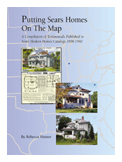 Putting Sears Homes on the Map: A Compilation of Testimonials Published
in Sears Modern Homes Catalogs 1908-1940 by historical architectural
researcher Rebecca Hunter.
Putting Sears Homes on the Map: A Compilation of Testimonials Published
in Sears Modern Homes Catalogs 1908-1940 by historical architectural
researcher Rebecca Hunter.
An important reference book for libraries, heritage commissions,
historical societies and individuals, this study presents the only
information available directly from Sears Roebuck and Company about the
specific locations of the homes they sold. Since Sears no longer has any
of its Modern Homes sales records, researchers have been looking for
potential Sears homes by doing street-by-street surveys in likely
communities. This book will make the process of discovering Sears homes
easier. This comprehensive compilation of testimonials from satisfied
customers published in Sears Modern Homes catalogs from 1908-1940 lists
geographical locations, street addresses, model names and names of
buyers. Over 1300 entries tell us that Sears sold homes in at least 43
states. The largest numbers of homes were sold in Illinois, Ohio, New
York, Pennsylvania and Indiana. While this represents only a small
fraction of all the homes Sears ever sold, it is an invaluable resource
for those interested in Sears homes. Since most of the testimonials
list only partial information, this book provides an opportunity for
others to contribute to knowledge about Sears homes by engaging in local
detective work to trace the names and addressees of original buyers,
and to search for missing street addresses of the listed models.
Copies are available from Amazon.com; or from R.L. Hunter Press by
phone, email, or postal mail.
Payment may be made by check or money
order made out to Rebecca Hunter.
Rebecca Hunter
903 Cedar Avenue, Elgin IL 60120
Telephone 847-697-4551
email: rebeccahunter1216@gmail.com
ISBN 0-9762096-0-8. Published 2004. 116 pages.
Price: $20.00
Shipping: $4.00 for a single copy — call for bulk order shipping rates.
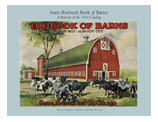 Sears, Roebuck Book of Barns: A Reprint of the 1919 Catalog with
a preface by historical architectural researcher Rebecca Hunter and architect
Dale P Wolicki.
Sears, Roebuck Book of Barns: A Reprint of the 1919 Catalog with
a preface by historical architectural researcher Rebecca Hunter and architect
Dale P Wolicki.
By now, most people are aware that companies such as Sears Roebuck, Gordon-Van Tine and Aladdin sold houses in mail order catalogs. Less known is the fact that five of the major mail order house companies also sold barns and other farm buildings. This is the first available reprint of a catalog of mail order barns. 1918 and 1919 were the years during which mail order catalogs offered the largest number and variety of farm buildings, hence the selection of the 1919 catalog for republication. The preface recounts the known history of mail order agricultural buildings from five companies, and is illustrated with photographs of authenticated Sears barns in Virginia, Michigan and Illinois. Included are a compilation of the models offered in known Sears barn specialty catalogs,
a bibliography for mail order houses and barns, and a listing of barn preservation resources in the United States.
The catalog contains descriptions and illustrations of the exteriors of the buildings, floor plans, and interior schematics for the larger barns. Included are twenty-seven models of barns, as well as hog sheds, chicken coops, granaries and other farm outbuildings.
Copies are available from Amazon.com; or from R.L. Hunter Press by phone, email, or postal mail. Payment may be made by check or money order made out to Rebecca Hunter.
Rebecca Hunter,
903 Cedar Avenue, Elgin IL 60120
Telephone 847-69-4551
email: rebeccahunter1216@gmail.com
ISBN 0-9762096-1-6. Published 2004. 84 pages.
Price: $20.00
Shipping: $4.00 for a single copy — call for bulk order shipping rates.
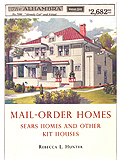 Mail-Order Homes by Rebecca L. Hunter
The rapid westward expansion of the United States in the early twentieth century set the stage for a new industry: mail-order homes. Sold by such companies as Sears, Roebuck & Co, Aladdin, Montgomery Ward, and Gordon-Van Tine, these kit homes were shipped to their purchasers by train or boat. Kits contained everything needed for construction, whether a vacation cottage, modest bungalow, or two-and-a-half story home. Precut and numbered framing boards were the hallmark of the kit home.
The author brings to life the history of these charming homes, tens of thousands of which were sold from 1906-1982, and many of which still exist. Fully illustrated, and containing numerous images from period catalogs, this book describes the customers who bought mail-order houses, the various styles and designs, and the boom and bust of the industry.
Copies are available from Amazon.com, or Shire Books, http://www.shirebooks.co.uk
ISBN 978-0-74781-048-3. Published 2012. 64 pages.
Price: $10.00
Shipping: $4.00 for a single copy — call for bulk order shipping rates.
___________________________________________________________________________________
LOCATING AND IDENTIFYING MAIL ORDER HOUSE PART NUMBERS
The framing boards of a precut kit house were numbered in order to facilitate construction. After the house is built, it is usually possible to see some of these numbers. Presence of part numbers constitutes proof that the house is in fact a mail order kit. The style and location of the numbering may be a good indicator of which company built the house. The numbers are not visible on every board, so it may take a few minutes and a good flashlight to find one. Look on floor joists in the basement, attic rafters, basement stair risers and treads, wall studs - any visible framing board which has not been painted. Even in a kit, numbers will not be found on boards that were not precut: e.g. flooring, trim boards, doors and windows.
1. SEARS part numbers are stamped in dark ink. They are about one inch high, and from 1915 to about 1930 usually are a capital letter followed by one or more numerals, (e.g. A159, L23, C2). The numbers are usually near the end of a board, on the wider surface (for example, on the 4" side of a 2X4). Later they may be stamped in red ink or may be 2 numbers separated by a hyphen or slash (e.g. 13 - 9). Sears homes before 1915 were not precut kits, and so were not numbered. Model number or order number may be handwritten in grease pencil.
2. GORDON-VAN TINE/WARDS numbers are handwritten in grease pencil, usually in the middle of a board. They most often consist of numerals, hyphenated in groups, e.g. 17-21-19, or 3-5 digit numerals. Part names are stamped in ink, capital letters about 1" high (e.g. "ceiling joist" "top rail"). Model or order numbers may be handwritten 4-5 digit numbers. Delivery address may be stamped or stenciled in ink.
3. ALADDIN, LEWIS and STERLING Company: early numbers are handwritten in grease pencil, usually in the middle of a board and consist of numerals, usually hyphenated in groups of 2 or 3. Some of the numbers are fractions, e.g. 42-18-11 3/4. Later (after about 1928) numbers may be stamped in ink, 2 numbers separate by a hyphen, e.g.12-1. Part names may be stamped in ink.
4. HARRIS Brothers numbers are stenciled in ink, usually in the middle of a board, and may be numerals alone, or numerals and letters (e.g. 76, HR 50, RI 32). Model number and/or order number may be handwritten in grease pencil. Part names may be stamped in ink.
5. PACIFIC HOMES parts are marked in grease pencil with 4-5 digit numbers, and the names of the parts.
ARCHITECTURAL SALVAGE OF SEARS HOME PARTS
The following original Sears parts are available to current owners of Sears homes. Contact information is listed at the end of each description. To list parts you have available, contact R Hunter at rebeccalhunter@sbcglobal.net or 847 697-4551.
1. Craftsman style porch columns for Americus, Vallonia, Cornell, Elsmore
model. Rebecca Hunter
847 697-4551.
2. Section kitchen cabinet from Sunlight model. Rebecca Hunter 847 697-4551.
3. 9 double hung sash windows: from an Americus model.
Quantity 3: 4 over 1, 32" wide, 56" high
Quantity 4: 4 over 1, 32" wide by 60" high
Quantity 2: 4 over 1, 32" wide by 51" high
Quantity 3: 3 over 1. 28" wide by 47" high
Rebecca Hunter 847 697-4551.
4. Various trim boards and a door frame. Rebecca Hunter 847 697-4551.
5. Triple front window plus storm windows for a Crescent, Hamilton (#3200) or Collingwood model. Rebecca Hunter 847 697-4551.
BIBLIOGRAPHY ON MAIL ORDER HOMES
Prepared by researcher Rebecca Hunter, 903 Cedar Avenue, Elgin IL 60120. 847-697-4551
Books
Connolly, Mc and Wasserman, L. Updating Classic America
Bungalows. Newtown CT: Taunton Press, 2002. Pp 118-121
"Restoring and enlarging
the Sears 'Sunbeam' model".
Fetters, Thomas. The Lustron Home. McFarland and Co, Box 611, Jefferson NC 28640, 2002.
Hunter, Rebecca. Beyond Sears: Mail Order Homes in Elgin Illinois from Aladdin, Lewis, Sterling, Harris Brothers, Gordon-Van Tine and Montgomery Ward. Elgin Heritage Commission 2004. Available from the Gail Borden Public Library, Elgin IL.
Hunter, Rebecca. Elgin Sears House Research Project. Elgin Heritage Commission 1999. Available from the Gail Borden Public Library, Elgin IL.
Hunter, Rebecca. Mail Order Homes. Shire Books: 2012. Available from http://www.shirebooks.co.uk
Hunter, Rebecca. Putting Sears Homes on the Map: A Compilation of Testimonials Published in Sears Modern Homes Catalogs from 1908-1940. Elgin IL; Rebecca Hunter 2004.
Johnson, Cynthia E. House in a Box: Prefabricated Housing in the Jackson Purchase Cultural Landscape Region. Kentucky Heritage Council, 2006.
McArthur, Shirley Du Fresne. Frank Lloyd Wright System Built Homes in Milwaukee. Northpoint Historical Society, PO Box 577, Milwaukee WI 53201, 1985.
Morgan Woodwork Organization. Homes and Interiors of the 1920’s. Ottawa, Ontario: Lee Valley Tools Ltd, 1987. A Reprint of the 1921 Building With Assurance.
Reiff, Daniel D. Houses from Books. University Park PA: Philadelphia State University Press; 1990.
Schweitzer, R. and Davis, M.W.R. America's Favorite Homes: Mail Order Catalogues as a Guide to Popular Early 20th Century Houses. Detroit: Wayne State University Press, Detroit 1990.
Schweitzer, Robert. Bungalow Colors: Exteriors. Salt Lake City: Gibbs Smith 2002.
Stevenson K.C. and Jandl H.W. Houses By Mail. National Trust for Historic Preservation, 1986. Available from John Wiley & Sons Inc, 605 3rd Ave., New York NY 10158-0012, 800 225-5945.
Thomas, Jo Ann. Lighting Fixtures of the Depression v I and II. Paducah KY: Collector Books, 2001.
Thornton, Rosemary. The Houses That Sears Built. Alton IL: Gentle Beam Publications, P O Box 1392, Alton IL 62002; 2002.
Thornton, Rosemary. Sears Homes of Illinois. Charleston SC: The History Press 2010.
Thornton, Rosemary and Wolicki, Dale Patrick. Montgomery Ward’s Mail Order Homes. Gentle Beam Publications, PO Box 3472, Portsmouth VA 23701; 2010
Wolicki, Dale Patrick. The Historic Architecture of Bay City Michigan. Bay City MI: The Bay County Historical Society, 1998.
Catalog Reprints
Aladdin.
Aladdin "Built in a Day"
House Catalog 1917.
Philadelphia and New York:
Athenaeum and Dover Publications; 1995
Bennett Lumber Co. Bennett’s Small House Catalog 1920. New York: Dover Publications,1993.
Gordon-Van Tine. 117 House Designs of the Twenties. Philadelphia and New York: Athenaeum and Dover Publications; 1992
Harris Brothers 1920 catalog http://www.antiquehome.org/House-Plans/1920-Harris/
Harris Brothers 1923 catalog http://www.archive.org/details/harrishomesbeaut00harr
Pacific Homes: California’s Kit Homes: A Reprint of the 1925 Pacific Ready Cut Homes Catalog. Gentle Beam Publications, PO Box 3472, Portsmouth VA 23701, 2004. Preface by Rosemary Thornton and Dale Patrick Wolicki.
Sears Roebuck. Sears Roebuck Catalog of Houses 1926. Philadelphia and New York: Athenaeum and Dover Publications 1991
Sears Roebuck. Homes in a Box: Modern Homes from Sears, Roebuck and Co. Schiffer Publishing: Altglen PA, 1998.
This is a reprint of a 1912 Sears Modern Homes catalog
Sears Roebuck. Sears, Roebuck Book of Barns: A Reprint of the 1919 Catalog. Elgin IL: R L Hunter Press 2005. Preface by Rebecca Hunter and Dale Patrick Wolicki.
Sears Roebuck. Sears, Roebuck Homes of Today 1932. Philadelphia and New York: Athenaeum and Dover Publications, 2003
Sears Roebuck. Sears, Roebuck Home Builder's Catalog 1910 Edition. Philadelphia and New York: Athenaeum and Dover Publications, 1990
Sears Roebuck. Sears Modern Homes, 1913. Philadelphia and New York: Athenaeum and Dover Publications, 2006.
Montgomery Ward. Wardway Homes, Bungalows and Cottages 1925. Philadelphia and New York: Athenaeum and Dover Publications; 2004
Articles
Betcone, David Stewart. “Fifty Million Dollars on a
Shoestring”. History of Aladdin Company.
Billings, Mark. “In Praise of Kit Homes”. American Bungalow, Spring 2003.
Halpin, Kay. “Sears Roebuck’s Best Kept Secret”. Historic Preservation, Sep 1981.
Hicks, L Wayne. “The House is in the Mail”. American History, April 2000.
Hunter, Rebecca “Kit and Precut Homes: An American Architectural Phenomenon”. Preservation and Conservation Association Newsletter, vol 23 No 3-4, Champaign IL 2003.
Hunter,
Rebecca. “Yes, Virginia, Sears Did Sell Barns”. Preservation and
Conservation Association Newsletter, Vol. 27 No 4,
Champaign IL
2007
Mann, Leslie. “Pride of Place”. Cottage Living, March 2008.
Massey, James C and Maxwell, Shirley. “Those Amazing Aladdins”. Old House Journal, July/August 2007.
Maxwell, Shirley and Massey. James C. “Pre-Cut Houses”. Old House Journal, Nov/Dec 1990.
Maxwell, Shirley and Massey, James C. “The Story on Sears”. Old House Journal, Aug 2002.
McGrath, Harold. “Sears, Roebuck Turns Builder”. Building Age April 1939
Murray, Alan. “Mail Order Homes Sears Sold in 1909-37 are Suddenly Chic”. The Wall Street Journal, February 11, 1985.
Poore, Patricia. “Pattern Book Architecture: Is Yours a Mail Order House?” Old House Journal, Dec 1980.
Reiff, Daniel D. “Identifying Mail Order and Catalog Houses”. Old House Journal, v. 5 1995.
Schwartz, David M. “When Home Sweet Home Was Just a Mailbox Away”. Smithsonian, Nov 1985.
Schweitzer R. and Davis M.W.R. “Aladdin’s Magic Catalog”. Michigan History, Jan-Feb 1984.
Snyder, Tim. “The Sears Pre-cut: A Mail Order House for Everyone”. Fine Homebuilding, Aug-Sep 1985.
Thornton, Rosemary. “The Sears Homes: Quality Homes Made to (Mail) Order”. Historic Illinois, v. 25 No. 2. Illinois Historic Preservation Services August 2002.
Wolicki Dale Patrick. “Aladdin Homes: Comfortable, Convenient and Cozy." American Bungalow, Summer 2003.
Wolicki, Dale Patrick. “Gordon-Van Tine Company”. ickilow inc., 2002.
Wolicki, Dale Patrick. “The Historic Architecture of Bay City Michigan”. Bay County Historical Society 1998.
Wolicki, Dale Patrick and Gore, Todd. Aladdin Homes: “Comfortable, Convenient and Cozy”. American Bungalow #38, 2003.
On The Web
www.gailborden.info : website for Elgin Public Library. Select “Research”, then choose “Photographs,” click on Illinois Digital Archives”, then choose “Elgin Sears House Research Project”.
www.gordonvantine.com : Gordon-Van Tine history and images of houses
www.kithouse.org : Services and publications by historical architectural researcher Rebecca Hunter.
Includes architectural salvage items.
www.lib.cmich.edu/clarke/aladdin/catdir/htm : Clarke Library, University of Central
Michigan, holds the original sales records of the Aladdin Company
www.lustron.net and groups.yahoo.com/group/LustronHomes : information on all-steel Lustron
homes; list of home locations.
www.melroseparklibrary.org/mailorder/ : apparent mail order homes in Chicago’s western suburbs
www.searsarchives.com/homes : The website of Sears Roebuck Archives, including the
national Sears Home Registry.
www.searshomes.org : website of Rosemary Thornton, author of The Houses That Sears Built
http://mailorderhomesofparkridge.blogspot.com/ : Mail order homes in Park Ridge IL
www.wardwayhomes.com : Homes marketed by Montgomery Ward 1909-1931.
Original Catalogs and Company Records
ALADDIN, LEWIS, STERLING COMPANIES
Bay County Michigan Historical Society owns many of these catalogs. 321 Washington Ave, Bay City MI 48708. 989 894-5733.
Aladdin Company built examples of most of its homes in Bay City MI.
Clark Historical Library, Central Michigan University, Mount Pleasant MI, holds the Aladdin Company sales records.
Contact Frank Boles, 989 744-3352
GORDON-VAN TINE COMPANY
Davenport IA public library has 5 catalogs published between 1926 and 1941, as well as 3 catalogs of building materials
MONTGOMERY WARD
American Heritage Center, University of Wyoming, Laramie WY holds 14 home catalogs published between 1916 and 1931,
and 17 building materials catalogs. 307-766-4114
SEARS ROEBUCK
Sears Archives holds catalogs from 1908 to 1940, except 1910, 1911 and 1923.
847 286-9555, Archive@searshc.com, www.searsarchives.com
MULTIPLE COMPANIES
Gail Borden Library, Elgin IL 60120 has bound circulating photocopies of a number of catalogs from Sears,
Gordon-Van Tine, Pacific Homes, and Harris Brothers. 847 742-241
[Updated March 2019]